China Top Cordless String Trimmer Manufacturers

Time:2026-10-10 Author:Isabella
0%

China’s cordless outdoor equipment market has changed quickly. The Cordless String Trimmer now appears in gardens, parks, farms, and professional landscaping crews.

China’s manufacturers compete through battery platforms, motor efficiency, cutting width, and vibration control. These details matter during real work. A wide cutting head can clear weeds faster, but it may drain the battery sooner. A lighter shaft reduces fatigue, especially beside fences and stone paths. Brushless motors usually provide stronger performance and longer service life, although product quality varies between factories.

Kris Kiser, president and CEO of the Outdoor Power Equipment Institute, has said, “Consumers should choose equipment based on the job they need to do.” His point remains practical. Buyers should examine runtime, charging speed, replacement batteries, noise levels, and after-sales support. Marketing claims alone are not enough.

This guide reviews leading Chinese Cordless String Trimmer manufacturers through an E-E-A-T-focused lens. It considers manufacturing experience, engineering capability, certifications, battery safety, and supplier reliability. Factory visits, product testing, technical documents, and customer feedback should all influence a serious evaluation. Some brands offer impressive specifications on paper. Their field performance may tell a different story.

There is no perfect model.

A compact trimmer may suit household edges but struggle with thick grass. A commercial unit may provide greater power but feel unnecessarily heavy for small gardens. Readers should compare actual working conditions, not only catalogue prices. This approach can reveal which Chinese manufacturers deliver dependable value and which still need improvement.
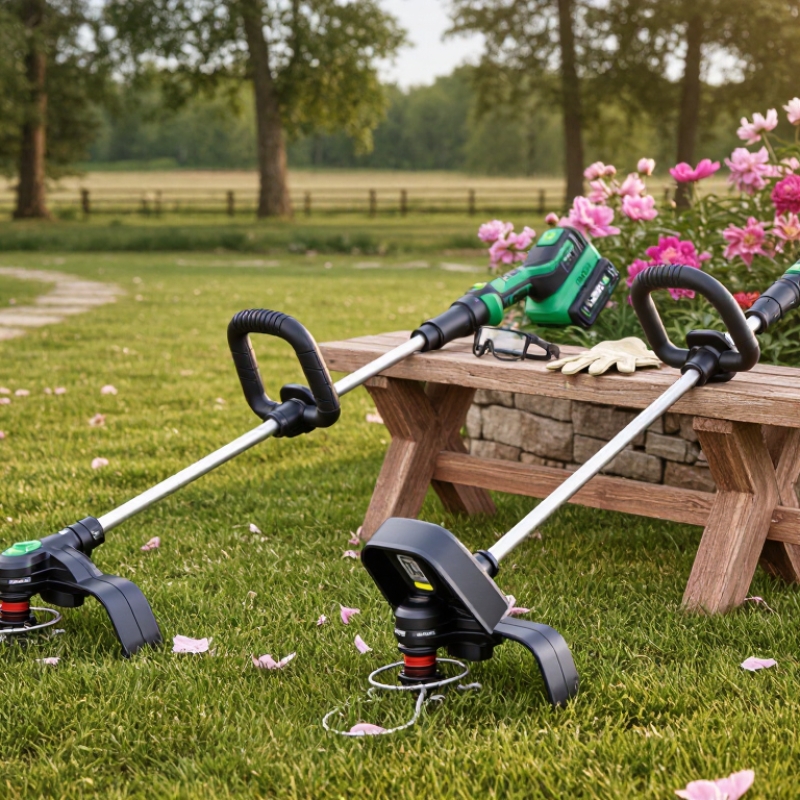
China Top Cordless String Trimmer Manufacturers

Industry Overview of China’s Cordless String Trimmer Manufacturers

China’s cordless string trimmer industry is moving from low-cost assembly toward integrated product engineering. Grand View Research estimates that the global cordless garden equipment market will expand at a strong compound annual growth rate through 2030. This trend supports Chinese manufacturers with established battery, motor, and plastic-molding capabilities. Many factories now combine brushless motors, lithium-ion battery packs, adjustable shafts, and automatic line-feeding systems.

Production depth matters. A typical Chinese supplier may machine motor housings, test battery cells, inject protective covers, and complete final assembly under one roof. This structure can shorten development cycles and reduce component costs. China’s manufacturing strength also supports flexible orders, including different cutting widths, shaft lengths, and safety guards. However, product consistency still depends on battery matching, waterproofing tests, and long-term motor validation. Cheap samples can hide weak thermal control.

According to MarketsandMarkets, the global power tools market is projected to grow steadily toward 2030, supported by cordless adoption and improved battery technology. Industry reports also identify runtime, charging speed, noise, and ergonomic weight as key buying factors. These findings fit current Chinese production priorities: higher energy density, lighter housings, and reduced vibration. The picture is not perfect. Some suppliers still emphasize headline voltage instead of measured runtime. Buyers should request cycle-test records, torque data, charger certifications, and spare-parts policies. Reliable manufacturers increasingly provide these details, but verification remains essential.

Small differences matter.

Key Technologies Used in Cordless String Trimmer Production

China’s cordless string trimmer manufacturers increasingly focus on motor efficiency, battery safety, and production consistency. MarketsandMarkets estimates the global cordless power tools market could grow from about USD 20 billion in 2023 to more than USD 30 billion by 2028. This demand encourages factories to replace brushed motors with brushless DC systems. These motors reduce friction, extend operating life, and deliver steadier cutting power through thick grass.

Lithium-ion battery packs usually combine high-energy cells with a battery management system. The controller monitors temperature, voltage, and current during charging and trimming. Many commercial trimmers use 20V or 40V platforms, depending on cutting width and torque requirements. A wider 40V model can handle dense weeds, but it also adds weight near the operator’s hands. That trade-off remains difficult. Reports from the International Energy Agency show continued growth in lithium-ion battery deployment, yet cell quality and thermal control still require strict factory testing.

Production lines now use automated winding, torque-controlled screwdrivers, and end-of-line load tests. Technicians may check shaft vibration, trigger response, noise, and runtime with real grass samples. Injection-molded housings need accurate cooling channels and reinforced joints. Small dimensional errors can create rattling after repeated use. Some manufacturers also add electronic soft-start functions and sealed control boards for dusty environments. However, laboratory runtime figures may not match wet grass, uneven soil, or neglected maintenance. Reliable testing should expose those weaknesses before shipment.

China Top Cordless String Trimmer Manufacturers - Key Technologies Used in Cordless String Trimmer Production

The following table summarizes commonly used technologies, materials, and production benchmarks in cordless string trimmer manufacturing. Technical values are typical industry ranges and may vary by product configuration and application.

Technology or Production Area Typical Technical Specification Core Components or Materials Manufacturing and Quality-Control Focus Main Performance Benefit Typical Product Positioning
Brushless DC Motor 18–60 V platform compatibility; electronic commutation with no replaceable carbon brushes Permanent magnets, copper windings, laminated steel stator, sealed bearings, electronic controller Rotor balancing, winding consistency, bearing alignment, thermal testing, and no-load current inspection Higher motor efficiency, reduced maintenance, longer service life, and improved runtime compared with brushed designs Professional and high-performance models
Lithium-Ion Battery System Commonly 18–40 V nominal platforms; removable battery packs with multiple cylindrical cells Lithium-ion cells, nickel-plated busbars, plastic housing, connectors, insulation materials Cell matching, weld strength, insulation distance, pack capacity verification, and charge-discharge cycle testing High energy density, low self-discharge, and convenient cordless operation Consumer and professional platforms
Battery Management System Overcharge, over-discharge, overcurrent, short-circuit, and temperature protection Protection IC, current sensor, temperature sensors, MOSFETs, control board, and communication contacts Protection-trigger testing, thermal monitoring, abnormal-load testing, and connector reliability checks Improves battery safety, operating stability, and usable battery life Essential safety technology
Electronic Speed Control Variable-speed trigger with pulse-width modulation and optional preset speed modes Microcontroller, MOSFET power stage, trigger assembly, Hall sensors, and control firmware Trigger response, speed stability, electromagnetic compatibility, and overload recovery testing Provides better control for grass density, edging, and battery consumption Adjustable-performance models
High-Efficiency Cutting Head Common line diameters: 1.6–2.4 mm; bump-feed or automatic line-feed designs Nylon cutting line, glass-fiber-reinforced polymer spool, impact-resistant head cover, and metal fasteners Spool balance, line-feed reliability, impact resistance, wear testing, and rotational endurance testing Consistent cutting width, reduced jamming, and easier line replacement General-purpose landscaping
Aluminum or Steel Drive Shaft Rigid or split-shaft construction; shaft length commonly designed for ergonomic reach Extruded aluminum tube, alloy-steel drive cable or rod, gears, couplings, and protective bushings Concentricity, torsional strength, coupling fit, corrosion resistance, and vibration testing Transfers motor torque efficiently while controlling total tool weight Durable and serviceable designs
Telescopic Handle Adjustment Tool length adjustment through a locking collar or lever mechanism Anodized aluminum tube, reinforced polymer collar, steel locking pin, and ergonomic grip Locking-force verification, repeated adjustment cycles, dimensional tolerance, and load testing Improves user comfort and accommodates different operator heights Ergonomic consumer models
Ergonomic Auxiliary Handle Adjustable loop or multi-position handle with anti-slip contact surfaces Glass-fiber-reinforced nylon, thermoplastic elastomer grip, clamp, and fasteners Grip strength, clamp slippage, material aging, and vibration-transfer assessment Improves control during edging and reduces hand and wrist fatigue Comfort-focused designs
Vibration Reduction Balanced rotating assembly and elastomer isolation at the handle or motor interface Elastomer mounts, balanced spool, precision bearings, damping sleeves, and reinforced housing Vibration measurement, rotor balance, fastener retention, and endurance testing Enhances comfort and helps reduce fatigue during extended operation Extended-use applications
Thermal Management Temperature-based current limiting and airflow or heat-dissipation paths in the motor housing Aluminum heat sinks, ventilation channels, thermal sensors, and heat-resistant polymers Continuous-load testing, blocked-vent testing, thermal cutoff verification, and housing temperature measurement Protects the motor and electronics from overheating under heavy grass loads High-load operation
Safety Interlock System Two-step start control, trigger lockout, and accidental-start prevention Safety switch, trigger mechanism, spring components, controller input, and molded housing parts Repeated actuation tests, switch reliability, drop testing, and abnormal-operation checks Reduces the risk of unintentional motor activation Standard safety feature
Debris Guard and Edging Guide Guard sized to control line debris; optional wire or molded edging guide Impact-resistant polypropylene or nylon, steel trimming blade, and corrosion-resistant fasteners Impact resistance, guard retention, blade sharpness, dimensional accuracy, and assembly inspection Improves operator protection and helps maintain a consistent edging path Lawn-care and edging models
Ingress Protection Design Sealed interfaces and drainage paths; protection level depends on the tested product design Gaskets, cable seals, housing joints, conformal coatings, and drainage channels Water-exposure testing, seal inspection, connector verification, and post-test electrical checks Helps protect electronics from dust, grass particles, and limited water exposure Outdoor-use equipment
Precision Plastic Injection Molding Automated or semi-automated molding for housings, guards, handles, and battery interfaces ABS, polypropylene, nylon, glass-fiber-reinforced nylon, and thermoplastic elastomers Dimensional inspection, weld-line review, flash control, impact testing, and color consistency Creates lightweight, repeatable, and ergonomically shaped components Mass-production manufacturing
Final Assembly and Traceability Torque-controlled fastening, functional testing, and serialized production records Electric screwdrivers, torque tools, test fixtures, labels, and inspection software Torque verification, no-load run test, battery compatibility check, noise inspection, and packaging audit Improves consistency, serviceability, and quality traceability across production batches Factory quality management

Leading Manufacturer Profiles and Product Specialties

China’s cordless string trimmer manufacturers increasingly serve residential, landscaping, and light commercial markets. Their profiles differ considerably. Integrated manufacturers often develop motors, battery packs, controllers, and plastic housings in one facility. OEM and ODM suppliers focus on flexible designs, private labeling, and smaller production runs. Specialist factories usually concentrate on high-efficiency motors, rotating heads, or ergonomic shafts.

Product specialties are becoming more measurable. Grand View Research estimated the global outdoor power equipment market at about USD 32.8 billion in 2023, with battery-powered equipment gaining share through lower operating noise and reduced maintenance. Manufacturers therefore highlight brushless motors, interchangeable batteries, adjustable handles, and automatic line-feeding systems. Professional models commonly offer higher voltage platforms and reinforced gearboxes. Residential versions prioritize lighter frames and simpler controls. A larger battery is not always better. It can increase fatigue during long trimming sessions.

Tips: Request test data for runtime, charging cycles, cutting diameter, vibration, and noise. Ask whether the stated runtime uses continuous cutting or light grass. That difference matters. Inspect shaft joints, trigger sealing, spare-part access, and charger certification before evaluating a supplier. Factory audits and sample testing remain essential. A polished sample may hide inconsistent assembly. That deserves honest checking. Industry reports provide market direction, but field trials reveal balance, heat buildup, and real cutting performance.

Quality Standards, Certifications, and Factory Capabilities

China’s leading cordless string trimmer manufacturers are judged by more than production volume. Factory discipline matters. MarketsandMarkets estimates the global cordless power tools market will reach about USD 40 billion by 2028, driven partly by battery-powered outdoor equipment. This growth increases pressure on Chinese factories to prove repeatable quality, not merely offer low prices.

Reliable plants normally operate under ISO 9001 quality systems and maintain documented incoming, in-process, and final inspections. Their trimmers should align with IEC 62841-4-1 safety requirements for lawn trimmers. Battery packs require careful control under IEC 62133-2, while UN 38.3 testing supports safer transport.

Certification marks alone are insufficient. Buyers should request current certificates, test reports, and production records linked to serial numbers.

Factory capability becomes visible on the workshop floor.
Look for torque-controlled assembly tools, battery aging tests, spindle vibration checks, and waterproofing inspections around the trigger housing. A practical supplier may test each motor for current draw and noise before packing.

Intertek’s 2024 consumer products data highlights increasing scrutiny of battery safety and product compliance across international markets. Still, factory claims can be incomplete. One weakness remains. Some suppliers outsource battery cells or chargers without strong traceability. Auditors should review supplier approval files, calibration records, corrective-action reports, and random samples from finished cartons. A small cut in the trimmer line can expose a larger process problem.

How to Evaluate and Select a Reliable Chinese Manufacturer

Selecting a reliable Chinese cordless string trimmer manufacturer requires more than comparing prices. Fortune Business Insights valued the global lawn and garden equipment market at USD 32.98 billion in 2023. It projects continued growth through 2032. Demand is moving toward quieter, battery-powered equipment. That shift increases pressure on battery safety, motor efficiency, and after-sales support.

Start with factory evidence. Request production records, incoming battery inspection reports, and samples from current batches. Check whether cells have traceable origins. Review capacity consistency, charger performance, and thermal protection. A serious supplier should explain testing against IEC 62841-4-4 and provide relevant regional compliance documents. Do not accept certificates without matching model numbers. Small details matter. Ask for a 30-minute cutting test using wet grass, dry grass, and thick weeds. Record runtime, vibration, heat, and line-feed failures.

The Freedonia Group has identified replacement demand and battery adoption as important factors in outdoor power equipment growth. However, report methodologies differ. Treat forecasts as direction, not proof. Visit the facility if possible. Inspect the assembly line, aging area, spare-parts stock, and final inspection station. A clean showroom proves little. Review defect rates, warranty claims, and corrective-action records from the previous twelve months. Clarify minimum order quantities, mold ownership, lead times, and battery replacement terms. A low quotation may hide weak cells or unstable supply. I have seen buyers focus too heavily on unit cost. That is an expensive mistake. Require a pilot order before long-term commitment.

FAQS

What capabilities do Chinese cordless string trimmer manufacturers commonly offer?

Many factories combine motor production, battery assembly, plastic molding, and final assembly. They may provide adjustable shafts, different cutting widths, safety guards, and automatic line feeding. Production depth can shorten development time. It does not guarantee consistent quality.

How should buyers compare battery performance?

Ask for measured runtime, charging time, battery cycle records, and thermal test results. Do not rely only on printed voltage. A trimmer showing high voltage may still provide short runtime. That difference matters.

What factory records should a buyer request?

Request incoming inspection reports, assembly records, calibration logs, and final inspection results. Serial-number tracking is useful. Ask for corrective-action reports when defects appear. Missing records deserve caution.

Which safety standards are relevant to cordless string trimmers?

Products should align with applicable lawn-trimmer safety requirements. Battery packs need suitable cell-safety testing. Transport testing may also apply to lithium-ion batteries. Certificates alone are not enough.

What should buyers inspect during a factory visit?

Look for torque-controlled tools, battery aging stations, and motor current testing. Inspect waterproofing around the trigger housing. Check vibration testing near the spindle. The workshop reveals more than polished samples.

Why are battery cells and chargers important quality risks?

Some factories outsource cells or chargers without strong traceability. Ask for supplier approval files and matching test documents. Check whether replacement batteries follow the original specifications. Small mismatches can create heat, poor runtime, or early failure.

How can buyers test a sample before placing a large order?

Run the trimmer until the battery stops, then record runtime and charging time. Measure noise, vibration, cutting consistency, and motor temperature. Repeat the test with several samples. One sample can mislead.

What product features are increasingly important to users?

Buyers often value longer runtime, faster charging, lower noise, and comfortable weight. Brushless motors may reduce maintenance and improve efficiency. Adjustable shafts can help users of different heights. Comfort is easy to underestimate.

What warning signs suggest a supplier needs closer verification?

Be careful when a supplier discusses voltage but avoids runtime data. Unclear battery sources are another warning sign. Weak waterproofing records and missing spare-parts policies also matter. I would not ignore these gaps.

Conclusion

China’s cordless string trimmer manufacturing industry has developed rapidly, supported by mature supply chains, strong engineering capabilities, and efficient large-scale production. Manufacturers typically focus on battery performance, brushless motor efficiency, lightweight structural design, adjustable cutting systems, vibration reduction, and safety controls. These technologies help improve trimming power, runtime, user comfort, and overall product durability for residential and professional applications.

Leading Chinese manufacturers may specialize in compact household models, high-performance landscaping equipment, or customized solutions for distributors and importers. When evaluating a supplier, buyers should review product quality, battery and charger safety, testing procedures, certifications, factory equipment, production capacity, quality-control systems, and after-sales support. A reliable manufacturer should also provide clear technical documentation, consistent sampling and mass-production standards, transparent communication, and flexible customization options. By comparing these factors carefully, buyers can select a dependable Cordless String Trimmer partner that offers stable quality, competitive pricing, and long-term cooperation potential.

Isabella

Isabella

Isabella is a dedicated marketing professional with a sharp focus on driving brand growth and engagement through strategic content creation. With an extensive background in digital marketing, she combines her passion for storytelling with her keen understanding of industry trends to deliver......