The Battery Chainsaw market is moving from a niche option toward a serious professional tool category. Grand View Research reports that the global electric chainsaw market was valued at approximately USD 1.5 billion in 2022, with continued growth expected through 2030. Fortune Business Insights also identifies cordless power equipment as a major driver of the wider outdoor power equipment market.
The shift is visible on job sites. A contractor can carry a 36V or 40V saw, two charged packs, and a compact charger into a managed woodland. There is no fuel can beside the truck. Less noise matters near homes, parks, and public trails. So does reduced maintenance. Husqvarna Group CEO Pavel Hajman has said, “Battery is the future of our industry.” That statement is brief, but important.
Still, battery performance is not magic. Runtime changes with bar length, wood density, temperature, and cutting technique. A saw that works well on pruning jobs may struggle with repeated hardwood cuts. Buyers should compare watt-hours, charging time, chain-brake response, spare battery pricing, warranty terms, and local service coverage. Many supplier pages emphasize voltage first. That can mislead.
This guide examines leading Battery Chainsaw suppliers for global buyers. It considers manufacturing experience, certifications, product testing, private-label capability, export reliability, and after-sales support. Market data can be incomplete, and supplier claims deserve verification. That is the uncomfortable part. A polished catalogue is not proof of field performance.
Reliable sourcing requires more than a low quotation. It requires evidence.
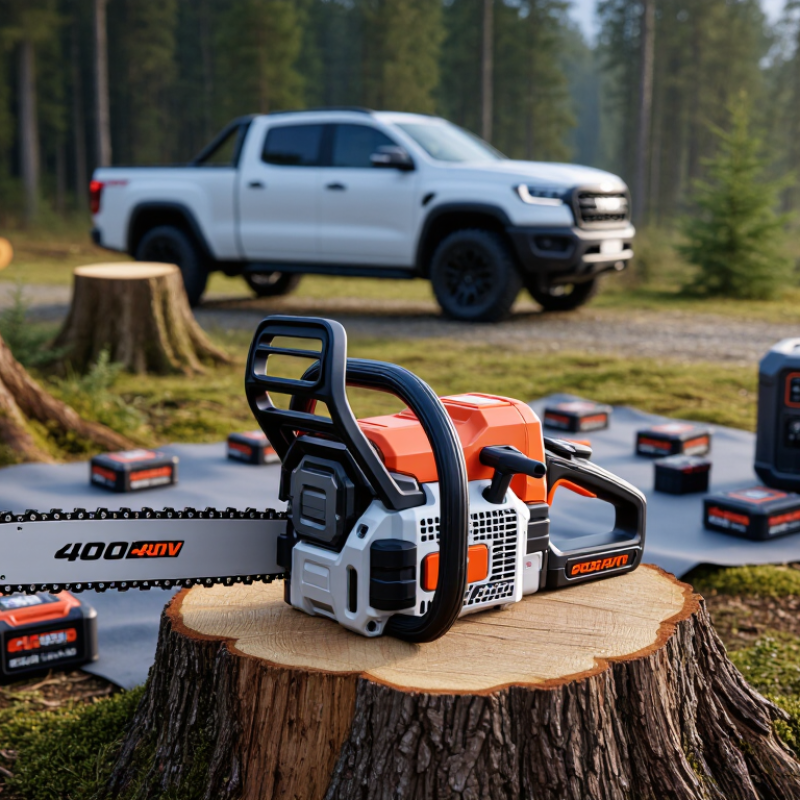
For global buyers, the 18V–80V range reflects distinct operating needs, not merely different product labels. An 18V system suits pruning and light garden work, while 36V–48V platforms usually support longer cutting sessions. Higher-voltage systems can deliver stronger chain speed under load, but they may increase weight, charger costs, and transport complexity. Voltage is not capacity.
Cell energy density also deserves close attention. Commercial lithium-ion cells commonly fall near 150–250 Wh/kg, depending on chemistry, format, and safety design. The U.S. Department of Energy’s Battery500 program treats 500 Wh/kg as a long-term research target, not a normal retail specification.
Buyers should request cell-level data, then compare it with the complete pack. Housing, wiring, cooling, and battery-management electronics reduce practical pack density. Real use varies.
BloombergNEF reported an average lithium-ion battery-pack price of 115 US dollars per kWh in 2024, although outdoor power-equipment packs can cost more because of lower production volumes and rugged protection. This figure helps suppliers explain pricing, but it should not replace testing.
Ask for cycle-life results, low-temperature performance, charge-time records, and protection compliance under IEC 62133-2 and UN 38.3 requirements.
I would also verify whether the advertised 80V figure means nominal or maximum voltage. That distinction is easy to miss. A supplier with clear test conditions, traceable cells, and realistic runtime claims is usually more reliable than one advertising the highest number.
When evaluating battery chainsaw suppliers, start with the cutting system, not the catalog price. Bars between 20 and 40 cm suit pruning, firewood preparation, and light property maintenance. Shorter bars improve balance in narrow spaces. Longer bars provide useful reach, but they also demand more motor control.
A chain speed of 5–15 m/s offers a practical range for different workloads. Lower speeds can improve handling during careful trimming. Higher speeds may cut faster through clean, dry wood. Suppliers should provide measured speed data, chain pitch, gauge, and compatible replacement parts. Ask for test conditions. Marketing figures without testing details deserve caution.
Battery capacity between 2 and 5 Ah can cover compact tools and heavier daily tasks. A 2 Ah pack keeps weight low. A 5 Ah pack usually supports longer operation, though runtime depends on wood density, chain sharpness, and cutting pressure. Field trials matter more than impressive claims. They often reveal heat buildup, slow charging, or uncomfortable balance. Request sample units, safety documentation, warranty terms, and spare-battery availability before placing a large order. Supplier reliability also depends on consistent production records and responsive technical support. Some specifications may change between batches, so written confirmation is essential.
Top Battery Chainsaw Suppliers for Global Buyers
OEM comparison should begin with measured runtime, not battery voltage alone. The International Energy Agency reported that electric vehicle battery demand exceeded 750 GWh in 2023. This scale supports better cells, but chainsaw packs still vary widely. Ask suppliers for cutting-time tests using the same bar length, wood diameter, chain pitch, and battery capacity. A practical profile should show 25–45 minutes of intermittent cutting, not only no-load operation.
Motor power needs equal attention. A 1,500–2,000-watt brushless motor can handle routine logs, while higher output helps with hardwood and thicker timber. However, peak wattage can disguise weak thermal control. Request stall protection data, chain speed under load, and temperature readings. The IEC 62841-4-1 safety standard provides a useful testing reference, though it does not guarantee equal field performance.
MOQ and lead time often expose the real supplier capability. Smaller OEM factories may accept 100–300 units, but custom housings, packaging, or firmware can raise the minimum order. Established exporters commonly quote 30–60 days for repeat production and longer periods for new tooling. Confirm battery-cell availability in writing. IEA data shows battery supply is expanding, yet regional shortages remain possible. One caution: promised runtime may change after packaging or safety revisions. Treat every figure as a starting point. Request production samples, inspection records, and a signed specification before placing a large order.
| OEM Supplier Profile | Battery Platform | Recommended Bar Length | Motor Power | Typical Runtime* | Chain Speed | Indicative MOQ | Estimated Lead Time** | Best-Fit Buyer |
|---|---|---|---|---|---|---|---|---|
| Profile A — Compact Private-Label Platform | 18–20 V lithium-ion | 8–10 in / 20–25 cm | 500–800 W peak | 25–45 min per 2.0 Ah battery | 5–8 m/s | 100–300 sets | 25–40 days | Home gardening and light pruning |
| Profile B — General-Purpose Retail Platform | 20 V lithium-ion | 10–12 in / 25–30 cm | 700–1,200 W peak | 30–55 min per 4.0 Ah battery | 8–12 m/s | 100–500 sets | 30–45 days | DIY, garden centers, and e-commerce |
| Profile C — Brushless Mid-Range Platform | 36 V lithium-ion | 12–14 in / 30–35 cm | 1,000–1,600 W peak | 35–65 min per 4.0 Ah battery | 10–15 m/s | 100–300 sets | 35–50 days | Landscaping and frequent residential use |
| Profile D — High-Output Retail Platform | 40 V lithium-ion | 14–16 in / 35–40 cm | 1,500–2,200 W peak | 30–60 min per 5.0 Ah battery | 12–18 m/s | 200–500 sets | 40–55 days | Professional landscaping and rental channels |
| Profile E — Extended-Runtime Platform | 48 V lithium-ion | 16 in / 40 cm | 1,800–2,500 W peak | 35–70 min per 5.0 Ah battery | 14–20 m/s | 200–500 sets | 45–60 days | Property maintenance and light forestry work |
| Profile F — Heavy-Duty OEM Platform | 56–60 V lithium-ion | 16–18 in / 40–45 cm | 2,000–3,000 W peak | 30–65 min per 6.0 Ah battery | 15–22 m/s | 300–1,000 sets | 50–75 days | Commercial outdoor power-equipment distributors |
Global buyers assessing battery chainsaw suppliers should treat compliance evidence as a purchasing requirement, not a marketing detail. CE and UKCA marking show that the supplier has completed the required conformity process for the destination market. They are not safety standards themselves. Ask for the Declaration of Conformity, technical file summary, risk assessment, and traceable test reports.
UL 62841 and IEC 62841-4-1 address important safety risks in hand-held chainsaws, including electrical protection, mechanical hazards, guarding, and abnormal operation. A credible supplier should identify the exact edition used. Test reports should match the model, battery pack, charger, and production configuration. Small differences matter.
The European Commission’s Safety Gate report recorded 3,412 product alerts in 2023. Compliance gaps remain common. That figure should make buyers cautious. Battery performance data also needs practical verification. Request cold-start tests, chain-brake response records, charger protection results, and repeated-cycle capacity measurements.
The International Energy Agency reported continued growth in global battery demand in its Global EV Outlook 2024, but chainsaw suppliers face different load patterns. High current bursts can expose weak cells or thermal controls. Paperwork helps, but it is not proof of field reliability. Some suppliers provide excellent certificates yet incomplete production controls. That weakness deserves a factory audit and a second review.
Global buyers need more than a low quote when comparing battery chainsaw suppliers. A practical evaluation matrix should score IP protection, warranty coverage, landed pricing, and after-sales support. During site trials, inspect the saw after light rain, fine sawdust, and repeated battery changes. An IP rating can indicate resistance to water and dust, but only when supported by clear test documentation. Ask whether the rating applies to the complete tool, battery pack, or charging unit.
Warranty terms often hide the real cost of ownership. Check coverage periods for the motor, battery cells, charger, and chain brake separately. Confirm who pays freight, labor, and replacement parts when a fault appears. A two-year warranty sounds strong, yet exclusions for commercial use may make it weak. Request a written process with response times, claim evidence, and local repair options. Keep serial numbers and purchase records.
Compare landed cost, not just unit price. Include batteries, chargers, spare chains, customs, and expected replacement cycles. A cheaper package may become expensive after several battery failures. Ask suppliers for batch test records, safety instructions, and parts availability for at least three years. After-sales quality appears in small details: a readable manual, fast technical replies, and stocked brake assemblies. Promises are not proof. Test the support. I would still leave room for doubt, using sample orders, documented inspections, and references from similar working conditions before scaling purchases.
The chart compares anonymous supplier tiers using a normalized 0–100 buyer score across IP protection, warranty coverage, price competitiveness, and after-sales support. The benchmark reflects commonly published market ranges: IP54–IP56 protection, 12–24 month warranties, approximately US$150–1,000 product pricing, and support availability from basic to dedicated service channels.
An 18V system fits pruning and small branches. It is usually lighter and easier to carry.
These systems support longer cutting sessions and moderate logs. Expect more weight than an 18V setup.
No. Higher voltage can improve chain speed under load, but voltage is not battery capacity.
Commercial lithium-ion cells commonly provide about 150–250 Wh/kg. Real pack density is lower.
The complete pack includes housing, wiring, cooling, and control electronics. Those parts add weight.
Request 25–45 minutes of intermittent cutting. No-load runtime is less useful.
Use the same bar length, wood diameter, chain pitch, and battery capacity. Otherwise, comparisons become weak.
A 1,500–2,000-watt brushless motor suits routine logs. Ask for loaded chain speed and temperature readings.
Smaller factories may accept 100–300 units. Repeat production often takes 30–60 days.
Request samples, inspection records, cell availability, and a signed specification. Promised runtime may later change.
The global Battery Chainsaw market covers a broad range of cordless systems, from compact 18V models to powerful 80V platforms, with battery cells commonly measured around 150–250 Wh/kg. For buyers comparing suppliers, key specifications include 20–40 cm guide bars, chain speeds of approximately 5–15 m/s, and battery packs between 2–5 Ah. OEM evaluation should focus on runtime, motor output, minimum order quantities, production capacity, and lead times to ensure reliable sourcing for different market segments.
A complete purchasing review should also examine compliance with CE, UKCA, UL 62841, and IEC 62841-4-1 requirements. Additional factors such as ingress-protection ratings, warranty coverage, pricing structure, spare-parts availability, technical assistance, and after-sales response times can significantly affect long-term value. By using a structured evaluation matrix, global buyers can select suppliers that balance performance, safety, customization, delivery reliability, and total ownership costs.

SoarTop